



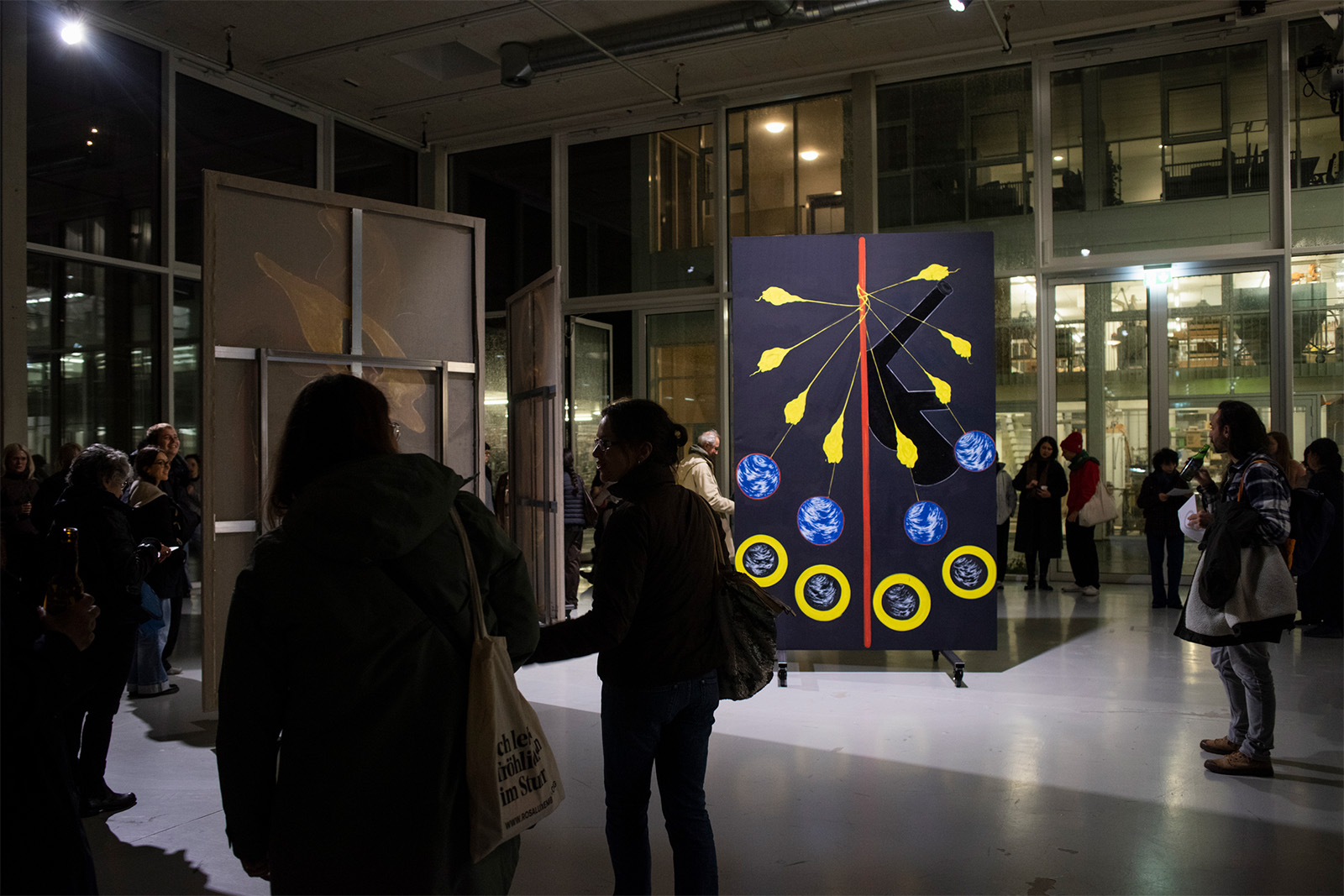
Opening Golnaz Hosseini Wheels, der TANK, Institute Art Gender Nature HGK Basel FHNW, 2026, photo: Christian Knörr
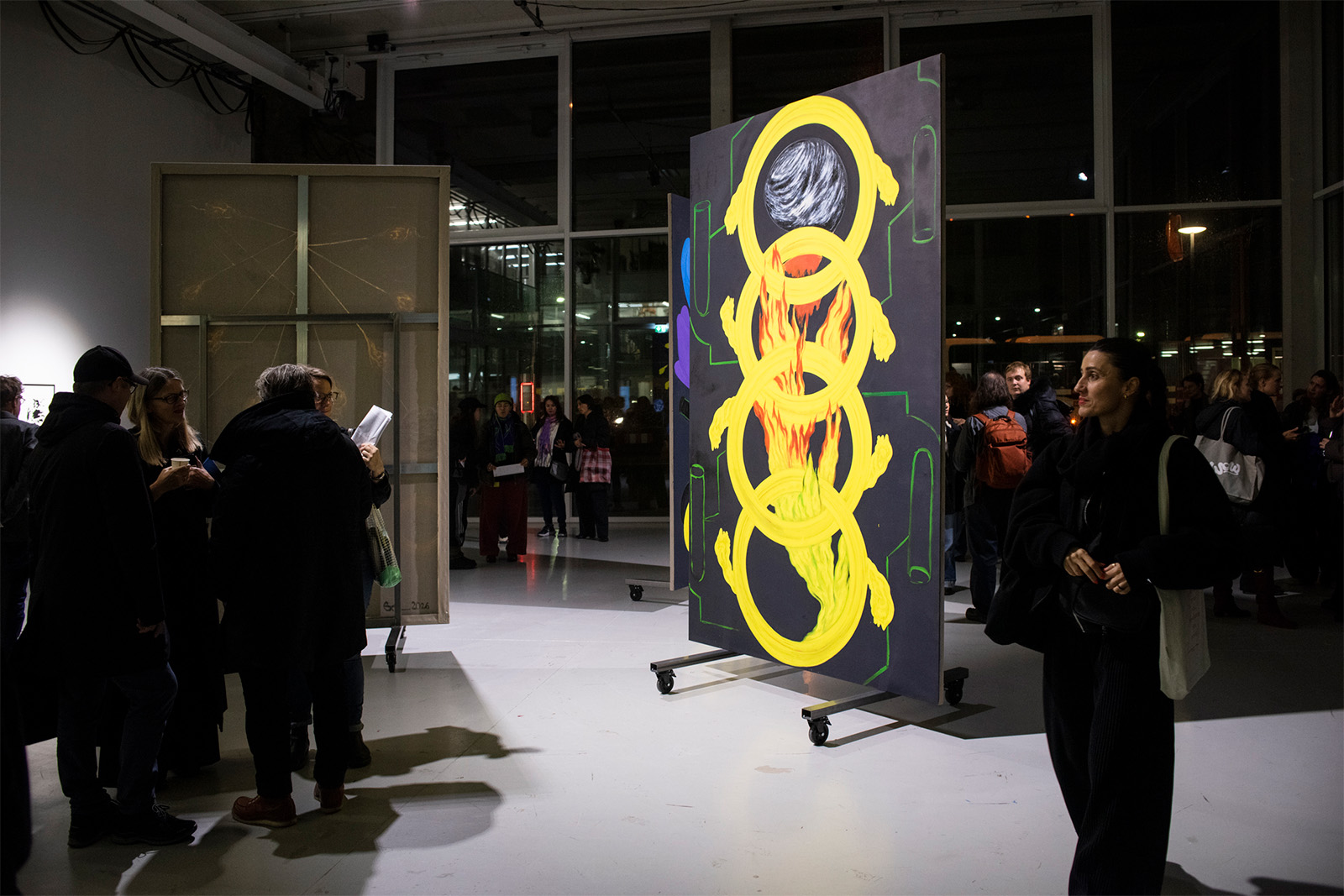
Opening Golnaz Hosseini Wheels, der TANK, Institute Art Gender Nature HGK Basel FHNW, 2026, photo: Christian Knörr
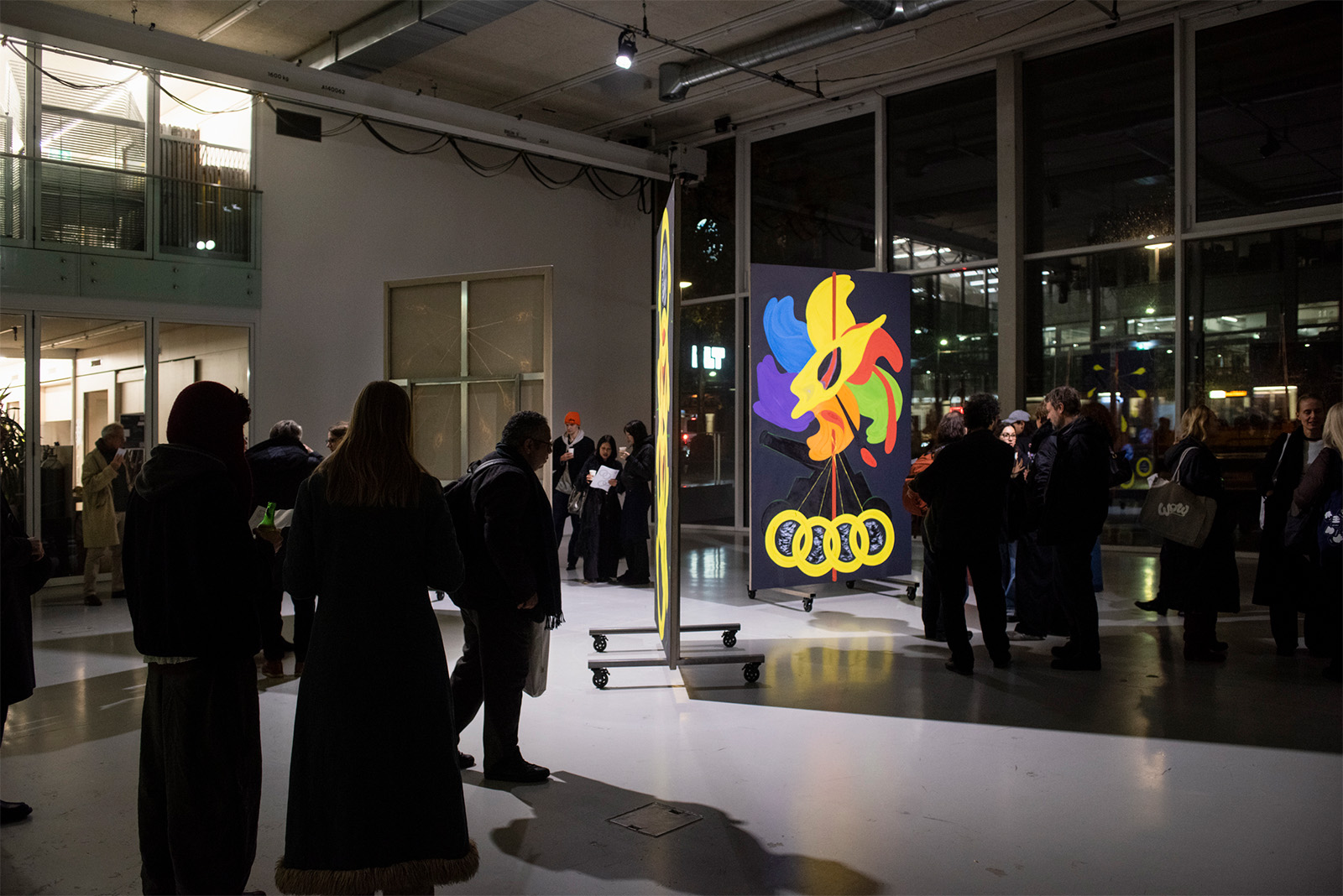
Opening Golnaz Hosseini Wheels, der TANK, Institute Art Gender Nature HGK Basel FHNW, 2026, photo: Christian Knörr
The Commissions
Golnaz Hosseini
Wheels
Curated by Roman Kurzmeyer
Opening Thur 12 November 2026, from 5.30 pm
Exhibition 13 – 22 November 2026
Opening hours
Friday, Saturday and Sunday, 5 – 8 pm
And by appointment: dertank.hgk@fhnw.ch
Golnaz Hosseini’s paintings possess a painful presence. This observation already applied to the first works the Tehran-born artist created in Basel and is reaffirmed by the new paintings presented in the exhibition Wheels at der TANK. Her painting is generally characterized by intense color and great force, despite a highly reduced palette. Alongside the achromatic colors black, white, and gray, she works primarily with the signal colors red and yellow, as well as blue. A characteristic aspect of the formal composition is the interplay between abstraction and representation. In a lecture on painting delivered in Paris in 1981, the French philosopher Gilles Deleuze (1925 – 1995) reminds us that, in the pictorial process, it is not forms but forces that are painted. The visible, he explains, is depicted in order to reveal the forces acting upon it. Force itself, by contrast, is formless. “The act of painting,” says Deleuze, “the pictorial fact, comes into being when form and force are brought into relation.” Yet a prerequisite for a painting that does not merely reproduce clichés is the willingness and ability to recognize all the images that already occupy the blank canvas before the actual work on the painting has even begun. Thus, according to Gilles Deleuze in his lecture on painting, the artistic act never begins with a blank sheet of paper or an empty canvas, but rather with the question: “What is given?”
Golnaz Hosseini’s more recent bodies of work, such as I fight you till I win, presented as an installation at Ausstellungsraum Klingental in Basel in 2023, and the triptych The Dust Enforcer (2022), which the artist exhibited in the graduation exhibition Peace or Never (2022) of the Institute Art Gender Nature HGK Basel FHNW, at Kunsthaus Baselland, are based on specific image programs. In The Dust Enforcer, Hosseini draws on the book Cyclonopedia: Complicity with Anonymous Materials (2008) by the Iranian-born, US-based philosopher Reza Negarestani, in which the Mesopotamian four-winged wind demon Pazuzu appears. For the exhibition Wheels at der TANK, Hosseini created three large-scale paintings that are installed as a cycle on picture carts arranged in a specific configuration within the exhibition space. The artist also presents a small work on paper that was created in June 2025 during the Twelve-Day War between Israel and Iran. Wheels takes its orientation from the visionary imagery of the prophet Ezekiel, who lived in Babylonian exile and whose visions are recounted in the Old Testament. These visions describe a four-wheeled celestial chariot whose wheels are covered with eyes and which could travel in all four cardinal directions without turning. These are images that place religion, power, and war, as well as the destruction and human suffering that follow in their wake, in direct relation to the idea of the omnipresence of a higher power. The ways in which power articulates itself across space and time throughout human history, and how it has inscribed itself into the histories of art and culture, constitute a recurring theme in the artist’s painting, one whose contemporary relevance requires no further justification.
The works on display evoke not only the paintings of yellow-edged daisies set against a muddy, dark background from the series Herbarium Life-minus, which Golnaz Hosseini painted between 2022 and 2023 and exhibited on various occasions, but also the different depictions of the sun as a fireball from her early work, which have burned themselves into my memory. Like those works from the series Dry Mouth (2020), which Hosseini painted during her first year of study in Basel, the new paintings also deal with uncontrollable forces and the processes of transformation they set in motion. In doing so, they draw on mythology. In her earlier large-format works on paper, the sun is depicted as a glowing fireball expanding across the picture plane, extinguishing every form of life on our planet. Hosseini’s images are representations of scorched earth, but not only that. They also evoke their opposite. Especially today, in light of the rapidly changing world order and the many wars that spread across the planet like a plague, they may appear as portrayals of dystopian or apocalyptic conditions and their inescapable dynamics. Yet, as I suspect, they are at the same time also expressions of an anticipated, or at least hoped-for, new beginning.
A work of art, in the view of the British philosopher Richard Wollheim (1923 – 2003), is never founded solely on the context in which it was created and made visible. In his book Painting as an Art (1987), based on the Andrew Mellon Lectures he delivered at the National Gallery of Art in Washington, D.C., in 1984, he suggests that an artefact may claim the status of art when it is the outcome of a realized process that is both pictorial and psychological, and when it encounters viewers who are capable of grasping the aesthetic intentionality of the act of painting.
The exhibition opening on 12 November 2026, from 5.30 pm, will take place following the first day of the Fall Symposium The Question of Class: Art Labor and Class Erasure, organized by the Institute Art Gender Nature and held on 12 and 13 November 2026.
dertank.ch/symposia
Wheels is the 18th project of a series of exhibitions, initiated in 2017, that presents commissions by former students and lecturers of the Institute Art Gender Nature at der TANK.